Showing posts with label nostalgia. Show all posts

Thursday, August 9, 2012

Final Fantasy IV

You can keep your fancy polygons:
16 bit is the life for me.
Before there were cutscenes, and polygonal graphics, and confusing combat systems, and teen angst, there was Final Fantasy IV (or Final Fantasy II as it was released in the United States to avoid then-confusion in exchange for now-confusion).  In addition to the game being simpler, I too was simpler: a boy of 8 or 9, unconcerned with taxes, or mortgages, or whether or not to use an Oxford comma when making lists.  And I was there with FF4, following the adventures of the sprite-like protagonists in - upon reflection - one of the most clear Final Fantasy stories ever.

The fourth iteration of the quite un-final Final Fantasy series told the story of Cecil, a dark knight who begins to question if exchanging his morals for power was all that great of an idea.  By extension, he questions the orders of King Baron for sacking the helpless mages of Mysdia to collect their Water Crystal (which, presumably has power - because it is so shiny).  For questioning orders, you are summarily dismissed on a final errand to deliver a package.

The package is actually a bomb, destroying the village Myst and all of its inhabitants (Summoners who threatened the king's plans) minus one girl who Cecil feels really bad about killing her mother and helps protect her.  In turn your party is complimented by the girl, Rydia, a Summoner; Rosa, your girlfriend; Yang, a martial arts master; Tellah, an old sage seeking vengeance for his murdered daughter, Edward, a spoony bard; Palom and Porom, twin mages from Mysdia; Cid, the first playable entrant of the recurring airship captain; Edge, a ninja; FuSoYa, a ridiculously over-powered mage for which you only briefly have control; and Kain, your former Dragoon companion gone-traitor after his own personal redemption.

Redemption is a recurring theme for FF4 - Cecil seeking redemption for being a Dark Knight (and becoming a Paladin), Edward seeking redemption for the cowardice that killed his fiance, Cid seeks redemption for helping build warships... the list goes on and on.  The story here is complicated, but in the way that epic tales are not simple, not the way that I have no idea what is what without reading an accompanying compendium.  There are the occasional cheap writing techniques, but all-in-all the game plays like a story unfolds: naturally.  And there are plenty an epic moment: becoming a Paladin, Rydia's triumphant return to the party, and flying to the moon.

I'm surprised! at how awesome I thought this looked as a kid.
Battle is active, turn-based, and menu-driven.  It's not quite to the perfected point of future Final Fantasies, but the unique ability sets each character develops are a nice addition.  Some battles are quite difficult without grinding, but they are mostly reserved to optional areas and the final dungeon.  Random encounters abound, but the game almost feels bad about throwing them at you: they start and conclude rather seamlessly with the world map.

And the world is well crafted, and huge.  There is an overworld, a world below, and the mother-fucking moon for you to explore.

The game is available in so many ways, you have no excuse not to be playing it right now.  It is available for the Wii in its SNES dumbed-down for American's version, the GBA re-release featuring additional difficulty (as was intended), the Playstation re-release on the PSN (not recommended due to horrible loading times) and a DS remake with polygonal characters and cutscenes (with voiceovers)!

Thursday, March 29, 2012

Kingdom Hearts I & II

I've been spending some time over the past couple weeks enjoying the seminal (meaning industry-advancing or significant, not semen-related) Kingdom Hearts games for the Playstation 2.  While the gameplay is nothing new, and the story bounces from whimsically simple to the Square-Enix induced complexity of a theoretical equation, the real standout of the game is the sheer depth of intellectual property fed into the game from both Disney and Square-Enix.

Kairi (left) and Sora (right) in an FMV.
Kingdom Hearts the first tells the story of Sora, Riku, and Kairi; happy-go-lucky youths who live on a small island and dream of exploring other worlds.  Their dream becomes reality when their world is "connected" to others through a menacing bad mojo known simply as "the darkness."  And this darkness also spawns monstrous concoctions known as Heartless, who errupt from a person whose heart fell to darkness.  Luckily, Sora is a chosen wielder of the Keyblade, a device that can destory Heartless and seal the doors between worlds.


Monday, February 13, 2012

The Legend of Zelda: The Skyward Sword

Skyward Sword takes place largely above the clouds.
Skyward Sword represents the first Zelda title for the Wii (as Twilight Princess was simultaneously released for both the Wii and Gamecube).  It also boasts itself as the first game in the chronology of over-arching Legend of Zelda story.

The game begins in Skyloft, a floating island town of bird-riding humans who are giving the bountiful land above the clouds as a gift from the goddess after her banishing of an ancient evil.  If you've played a Zelda game before you will not be surprised to discover that the banishment of that ancient evil has become slightly tenuous.  Luckily, you - Link - are the hero chosen by the goddess to protect the realm.

The titular sword, held skyward.
But before you go can do that, you have to visit some temples, pass trials, and otherwise prove your worth.  It's almost as if the entirety of the game is to complete quests to justify being selected as the chosen hero.  First you follow Zelda around, then you have to charge your sword with sacred flames, and complete some song.

Unfortunately, the variety of things to do doesn't correlate with an extensive world.  Outside of the above-clouds world of fractured, floating islands, only three worlds exist: a forest world, a fire world, and a desert world.  It feels very claustrophobic compared to Twilight Princess or even A Link to the Past.  Frequently, you are given reasons to revisit previous environments, sometimes under very thin pretenses.

The design of the game is a perfect blend of Twilight Princess' realism and Wind Waker's cell-shading.  Each world has a unique feel, especially musically.  

However, the design cannot cover up some of the game's biggest shortfalls.  I wish the worst I could say was that I was mesmerized into stupidity by Zelda's bangs, but it was far worse...

The first game flaw is the flavor of the month assistant, Fi.  While I have to accept the fact that Nintendo insists that its players are idiots and need an assistant to give guidance on every single facet of the game, I am greatly disturbed by the intense level of assistance that is constantly offered.  After learning about Zelda's next location, I can barely breathe before Fi errupts from the sword and says: "I'm 80% certain that Zelda is in this location, we should go there."

There are a lot of missed opportunities in Skyward Sword to establish some components of the overarching universe.  Story-wise, the game stands steady, but I'm disappointed at missed opportunities to add depth and explain the origins of long-standing Zelda characters.  At times, it almost felt like a game that was not designed to be a Zelda game, but was turned in to one.  Not that Nintendo hasn't done that before...

A Stalfos battle, requiring a specific Wiimote swing.
And finally, my misgivings couldn't be complete without commenting on the Wii MotionPlus motion controls.  The game boasts the use of MotionPlus in combat and solving puzzles, but in reality, it is an incredibly painful addition.  The Wiimote is critical seconds behind during combat situations, wherein almost every enemy has a motion-based defense, encouraging forcing the player to swing the Wiimote one direction or the other.

But if combat is clunky, it seems next to graceful compared to the Wiimote motion controls of the game's various mini-games.  Mini-games, and subsequent cursing at the world while playing them, are a staple of the Zelda world; however, these mini-games are rage inducing.  Not only must you contend with achieving scores that are nigh undoable, but you must also achieve those scores by using frustrating and inaccurate controls.

In spite of these shortcomings, the game is a lot of fun, albeit frustrating at times.  If you haven't grabbed it, check it out!

Link to purchase from Amazon.com: The Legend of Zelda: Skyward Sword with Music CD.

Friday, October 21, 2011

Final Fantasy VII


First released almost 15 years ago, Final Fantasy VII marked the long-running (and somewhat less than final) series' move from 16-bit graphics into the stunning world of polygons and CGI cutscenes.  For many, FFVII represented the first epic gaming experience.  I recently put FFVII into the backwards compatible PS3 to see how well the game had held up after all this time.

The story is a well-known one.  You play as Cloud, the ex-SOLDIER (a kind of elite fighting force of the Shinra Corporation) turned mercenary freedom fighter.  The game opens with Cloud's participation with Avalanche (eco-terrorists who want to stop Shinra's use of Mako energy - which they believe to be lifeblood of the planet) as they set explosives on a Mako Reactor.  Because the heavy dialogue sequences between characters are all text, it is much easier to communicate this complicated exposition than it might be with modern RPGs that have an abundance of voice-acting.

They story takes whims and weaves all over the place.  In addition to the leading plotline, there is a crisis of the very planet itself, wherein Cloud and his ragtag group of allies must confront the diabolical and other-worldly Sephiroth, who seeks to destroy the planet by summoning a huge meteor to crash (very slowly) into the planet.

When released, the game boasted some truly incredible graphics and graphical effects.  Some of it has been lost upon age, but for the technology available, the game still looks good.  Like sprite-based games before it, FFVII asks us to use our imagination to connect the polygons and make things life-like.  My imagination is happy to oblige!

And while the field graphics are the really painful ones, the battle graphics are actually very nice.  Enemies are still polygon-based, but there is limited reskinning and almost every enemy feels unique. 

FFVII has held up well, but I notice that while playing I've become very programmed by more modern games.  I am slightly disappointed that no trophies appear as I play, and the analog stick is completely non-responsive, making the use of the directional-pad standard.  But for nostalgia: it's worth it and then some.

Tuesday, April 5, 2011

Harvest Moon

Oh, cows.
Did you know that I used to be a farmer?  Like, I actually farmed things.  Seeds went into the ground, time ellapsed, and then mature fruits and vegetables were picked and sold.  This process taught me three important things:
  1. Farming is not a valid career choice for me.
  2. There is a point at which you cannot be any dirtier or any sweatier.
  3. Video games make things that are chores seem like fun.
There was a time when FarmVille was an insanely popular Facebook game.  Click to hoe ground.  Click to plant seeds.  Click to water.  Click to harvest and sell.  It was a pretty crappy time waster of a game, even for a resource management game, though it probably did teach some basic concepts of profit margins (they game could be even more edu-taining if it had some Drug Wars-esque supply/demand algorythms).  This is not how real farming worked, and whats more, Zynga wasn't the first company to capitalize on the notion of turning farming into a simple point here and do this; it was a Japenese company called Victor Interactive Studio, and localized for the United States by Natsume.

Harvest Moon (or rather, the Harvest Moon series, as there are about a dozen iterations now) was a sprite-based resource management game released for the Super Nintendo Entertainment System in 1997.  You control a young man who must repair a desolate farm, plant crops, make money, and woo a local townswoman to then be your wife.  Resource management describes games where you must balance a finite set of resources (in this instance, it is mostly time and stamina, although there are some aspects of space and money) in order to acheive your goals.  There is no mini-game aspect for planting: just move to where you want the seeds to go and push a button.

Again, I should iterate that this is not how real farming works.

I devoted a great deal of time that I could have actually have been farming to playing this game about farming, which probably says something about me and my generation, but I couldn't help it: the Harvest Moon formula worked. 

You're an open book, Rick.
I've started to play through Harvest Moon: Friends of Mineral Town - or more specifically, its sequel More Friends of Mineral Town.  The difference between the two is that the latter allows you to play as a female farmer and woo one of the male townsfolk.  The game is the same tried and true Harvest Moon.  Gotta clear the weeds and rubble from the farm, hoe the ground, plant the seeds, water the seeds, harvest the crops, feed the chickens, milk the cows, brush my horse... However More/Friends of Mineral Town is a lot more dating sim than the previous versions.

If you want to try your hand at farming, it'd probably be easier to try the above mentioned FarmVille, but you miss out on the nostalgia and (lite) interactive fiction of the Harvest Moon games.

Sunday, March 27, 2011

Staying Old School: GBA Metroid Platformers

I've spent the last week or so replaying games in the Metroid series.  In addition to being an absolute nostalgia-fest, I have been delighted that these games have held up so well.  The games have long held a place in my heart for being easy to learn, but difficult to master: collectible upgrades are hidden in the most unlikely (but fun to find) places, and simple, power-up based puzzles.

Also, your main enemy is a brain in a jar.  How cool is that?

Metroid: Zero Mission is a revamped telling of Samus Aran's first adventure to the planet Zebes, upgraded with Super Metroid-esque power-ups.  The game really shines in its execution of the original Metroid game with the new power-ups.  I was impressed particularly by a sections towards the end of the game that stripped you of many of your power-ups and forced you to rely on stealth.  It was excellently done.

Complete with traditional opening area!
The controls are greatly intuitive, which is excellent considering the Gameboy Advance's limited buttons.  And, given the GBA's capacities, the game is brilliant looking.

For a big departure from Zero Mission, I gave Metroid Fusion a try.  The same Super Metroid mechanics apply, but in this game, Samus is infected with X parasites and it greatly changes some gameplay aspects.  Enemies dispatched release their X parasites which recharge energy and missiles/bombs.  Power-ups are obtained by beating bosses who release specialized X parasites and grant Samus the abilities she once had.

If you are craving a stroll through platform-ville, give either of these GBA games a shot.  Good fun without much commitment whatsoever, you could easily blast through these games within a couple hours.

Monday, March 21, 2011

Castlevania: Aria of Sorrow

One day, I'd like to host a conference about conferences.  A meta-conference, if you will.  One of the sections will be named: "Naming Your Conference Sessions: Using Colons to Extend Your Thoughts Way Beyond a Simple Title."

Konami knows something of the use of the colon.  In its (many) series, the brand name is followed by a colon, in order to create a sub-brand using marketing witchcraft.  While it does cause there to be endless amounts of confusion, the method will seem genius once Pokemon runs out of colors (or valuable minerals), or Super Mario Transdimensionalism is released.  Castlevania: Aria of Sorrow is the focus of my colon related scorn (go on, giggle, you know you want to), which I recently got to play through again.  The game was released for the 32-bit Gameboy advance, which so far as you know is how I played it (and not at all on a downloaded "copy" of the game).

Can you feel the 32-bit love?

If you haven't played a Castlevania game before now, you really ought to, and Aria of Sorrow is a good a place as any.  The series is mired in mythos, but the essential storyline involves you (sometimes you're no one in particular, and sometimes you're a Belmont) and the famous Count Dracula and his castle of undead minions.  Very few titles attempt to go much deeper into things, though they go much, much deeper.  However, Aria of Sorrow (and its sequel, for there must always be a sequel, Dawn of Sorrow) are set at the end of a shit-ton of events that occured over several centuries.

You needn't understand any of this of course.  Jump with one button, thrust or swing weapon with another.  Hold up and use your weapon button for a special ability.  Side scrolling, platformer-RPG, and beuaty considering the 32-bit restriction. 

The fun of the game lies in its Soulset system, which allows you collect souls of fallen foes and equip them to your character, Soma Cruz.  Souls don't always appear, but appear with enough frequency to make collecting them fun, challenging, but not hair-pulling.  The game also features New Game Plus, which is like discovering a remaining Oatmeal Cream Pie when you had expected that you'd eaten all of them, but one remains, glistening, waiting for you sumptiously eat it.

No, serious, I love Oatmeal Cream Pies New Game Plus features, especially when they handicap me just a little bit, so the second (third, fourth, eighty-third) play-through continues to be enjoyable.  Castlevania: Aria of Sorrow acheives this in the same way most RPGs do with New Game Plus: by resetting your level.  You keep your uber equipment, all your souls, but you start back at the bottom, and must climb your way back up.  Except this time you've got a huge glowing white sword and the climb is easier, but still enjoyable.

All in all, since I clearly own this game and was able to find it, and did not in any way have to do anything that is questionably illegal to play it, this was worth the ten hours I spooged into it, and will probably serve me good for a few more on a couple extra playthroughs.  Now, I really must look intro procuring its offspring for the Nintendo DS...

Wednesday, March 2, 2011

Fallout: New Vegas


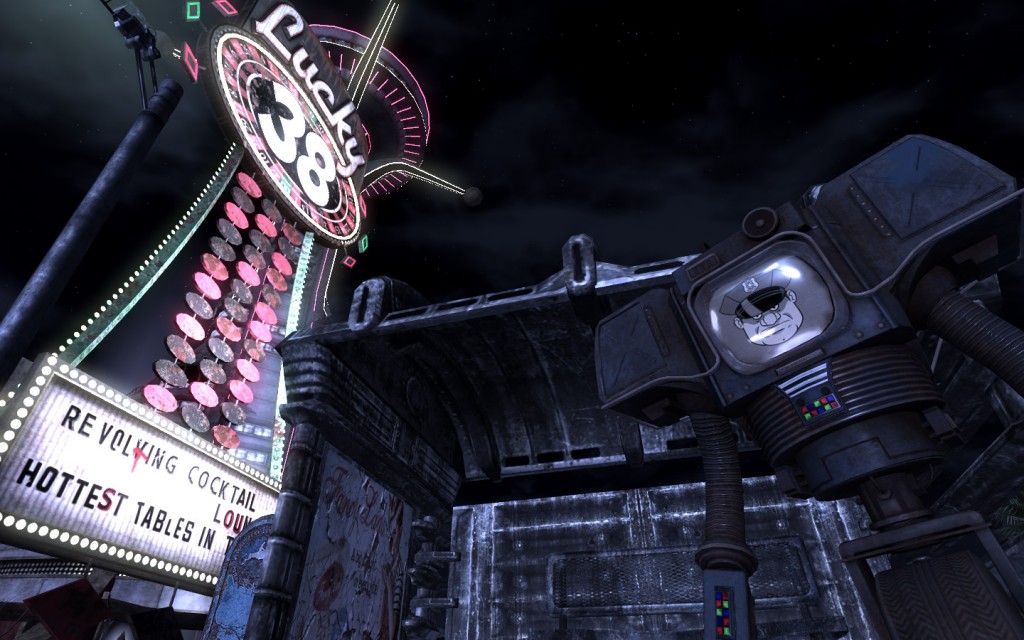
Fallout 3 had eluded me when it was first released, but now that I was on the fanboy wagon, I sure as hell wasn't getting off.  So when I heard about the next episode in the Fallout universe, I was eager to sink my teeth into its nummy, possibly irradiated flesh.  Not only would it be borrowing stealing completely reusing the engine of Fallout 3 (Fallout fans weren't really big on this, but I liked Fallout 3, and I was more than happy to be getting what some called a really big expansion pack), but it was set in Las Vegas.

Vegas and video games have a nice history about them.  Vegas Stakes, a Super Nintendo game, was my first introduction into gambling.  The game was nearly purposeless (goal: make money), but I still sank a great deal of my childhood into it.

Now I would be able to experience Vegas, set in a post-apocalyptic world!  And as the main character, I'd surely have a goal of some significance to the region (if not the world), so there would be plenty of story to accompany this game's foray into Sin City, even if my inaugural game was somewhat lacking.


The gameplay in Fallout: New Vegas was a big Ctrl-V from Fallout 3 (similar weapons, V.A.T.S., menu screens, etc.), but it did implement a few substantial changes: speech challenges increased in complexity, the small guns and big guns skills that were delineated before were merged into "Guns," and a "Survival" skill was added.  The ssurvival skill was particularly important for those playing the game on "Hardcore Mode," which would require the player to eat, drink, sleep, and recover from injuries in a more realistic way. 

During my first playthrough, I was incredibly nervous.  I still considered myself lucky to point my guns in the correct direction, and decided to play without "Hardcore Mode" engaged.  On the second (and subsequent) playthrough(s), I decided a spice of adventure was just what the game called for. 

I have had trips to the mailbox which I would classify as more hardcore than F:NV's "Hardcore Mode."

Don't get me wrong, the mode created some new complexity to the game, which may or may not have been challenging, but food, water, and places to nap are relatively frequent in the Mojave Wasteland.  But hardcore it was not.  The only substantially upsetting difference was that recruited characters could actually die when you had "Hardcore Mode" engaged, which was somewhat sad, but also somewhat of a relief as they were responsible for violating my stealth protocols to summon Cazadors to come and disembowel me.


The game gets a huge nod from me for being very, very, gay friendly - and not just in a shallow way!  A perk you can take early on, Confirmed Bachelor, gives you unique dialogue options with the same sex.  And while this could have been a token nod to LGBT fans of the series, there is actually some discourse on how gay and lesbian relationships are perceived, which heartily deepens the story.  I initially was predisposed to help the New California Republic (or NCR), which were who I perceived as the "good guys," but when I discovered that they frown on same-sex relationships, which are openly embraced by the slavers of Cesar's Legion, I thought maybe that was the way to go (the Legion transpired to be awfully patriarchal, so I went with the killing everyone strategy; let god sort 'em out).

The game also gets further nodding for its depth of story.  Fallout 3 featured a broad world, but what Fallout: New Vegas lacks in explorable square footage, it more than makes up in depth of its characters, story, and side quests.  There are four ways to beat the game, depending on to whom to pledge your allegiance, and gameplay is unique enough for each playthrough to keep me coming back.  Each faction in the Mojave has their own story to tell (or learn about from picking through the belongings on their bullet-ridden corpses).

The voice acting is pretty excellent, too.  Felicia Day voices a companion with whom I loved having close to me, mostly because it was like the real Felicia Day was sitting next to me, assuring me that everything was going to be okay, before punching the crap out of a Wasteland Raider.


The big problem with this game was glitches.  If I moved while reloading a weapon, or talked to an ally while enemies were approaching us in preparation to hack us to pieces, or I looked at my controller the wrong way, the game would freeze.  A freeze every blue moon is one thing, but it happened all the time.  And for an immersive game like Fallout: New Vegas, a sudden reminder that you are - in fact - alone on the couch and not heading towards the glitzy remnants of Las Vegas, is even more crushing.

All in all, I'd say Fallout: New Vegas is one of my favorite games, in spite of its glaringly frustrating freezes.  If you haven't picked it up and you like this sort of thing, I'd really recommend you do so.

Saturday, February 26, 2011

PS3 Demo: Back to the Future, The Game - Episode 1: It's About Time

...or, when blog titles are way too long.

I was deeply disappointed by this first entry in my demo weekend.  The graphic style of this Back to the Future setting adventure game is fun and comic booky, but I was instantly turned off by the childish goals, and inept camera controls (or lack thereof).  It's possible a hardcore Back to the Future fan would be interested to follow Marty's adventure in 1986 (and who knows when else), but this demo didn't sell it to me whatsoever.


The demo features the first challenge of the full episode, which only takes about 15 minutes to fully explore, plus some narrative (a dream sequence, how original).  The gameplay is what you'd expect from an adventure game: look around at stuff, collect items to solve puzzles.  I used to love this kind of thing!

The game earns itself a nostalgia tag for being able to reign in Christopher Lloyd to voice Doc Brown, but besides that, I was mostly unimpressed.  The five episodic adventures will set you back a mere $19.99 on the PSN, but it hardly seems worth it, right now.  The whole thing will go on sale on Steam sooner or later.