Friday, August 10, 2012

Flash Game Friday: Sky Garden

Sometimes, you actually have to do work at work, rather than pretend that you are a much beloved video game blogger, with users dedicate themselves to your every movement.  So, sometimes you have to work - and you're looking for a Flash-based distraction that will calm and relieve your stressful work life.
The graphics are simple, as is the gameplay.
Simple and calming.
Enter Sky Garden, a simple puzzle game with music that is so calming, it blends you slowly into a Friday afternoon coma.

The concept is simple: click every tree.  The tree releases a stream of water in all four directions as far as possible.  The streams built from clicking the trees will destroy any tree they touch, so the game casually introduces you to the strategy of using streams to block future streams.  Then, like any good puzzle game, new elements are introduced.  Seedlings require water to be born into trees.  Ice halts your streams' progress.  And lava slowly spreads, killing your trees.

I strongly recommend this game for its stupendous ease to pick up, play, and complete.

Thursday, August 9, 2012

Final Fantasy IV

You can keep your fancy polygons:
16 bit is the life for me.
Before there were cutscenes, and polygonal graphics, and confusing combat systems, and teen angst, there was Final Fantasy IV (or Final Fantasy II as it was released in the United States to avoid then-confusion in exchange for now-confusion).  In addition to the game being simpler, I too was simpler: a boy of 8 or 9, unconcerned with taxes, or mortgages, or whether or not to use an Oxford comma when making lists.  And I was there with FF4, following the adventures of the sprite-like protagonists in - upon reflection - one of the most clear Final Fantasy stories ever.

The fourth iteration of the quite un-final Final Fantasy series told the story of Cecil, a dark knight who begins to question if exchanging his morals for power was all that great of an idea.  By extension, he questions the orders of King Baron for sacking the helpless mages of Mysdia to collect their Water Crystal (which, presumably has power - because it is so shiny).  For questioning orders, you are summarily dismissed on a final errand to deliver a package.

The package is actually a bomb, destroying the village Myst and all of its inhabitants (Summoners who threatened the king's plans) minus one girl who Cecil feels really bad about killing her mother and helps protect her.  In turn your party is complimented by the girl, Rydia, a Summoner; Rosa, your girlfriend; Yang, a martial arts master; Tellah, an old sage seeking vengeance for his murdered daughter, Edward, a spoony bard; Palom and Porom, twin mages from Mysdia; Cid, the first playable entrant of the recurring airship captain; Edge, a ninja; FuSoYa, a ridiculously over-powered mage for which you only briefly have control; and Kain, your former Dragoon companion gone-traitor after his own personal redemption.

Redemption is a recurring theme for FF4 - Cecil seeking redemption for being a Dark Knight (and becoming a Paladin), Edward seeking redemption for the cowardice that killed his fiance, Cid seeks redemption for helping build warships... the list goes on and on.  The story here is complicated, but in the way that epic tales are not simple, not the way that I have no idea what is what without reading an accompanying compendium.  There are the occasional cheap writing techniques, but all-in-all the game plays like a story unfolds: naturally.  And there are plenty an epic moment: becoming a Paladin, Rydia's triumphant return to the party, and flying to the moon.

I'm surprised! at how awesome I thought this looked as a kid.
Battle is active, turn-based, and menu-driven.  It's not quite to the perfected point of future Final Fantasies, but the unique ability sets each character develops are a nice addition.  Some battles are quite difficult without grinding, but they are mostly reserved to optional areas and the final dungeon.  Random encounters abound, but the game almost feels bad about throwing them at you: they start and conclude rather seamlessly with the world map.

And the world is well crafted, and huge.  There is an overworld, a world below, and the mother-fucking moon for you to explore.

The game is available in so many ways, you have no excuse not to be playing it right now.  It is available for the Wii in its SNES dumbed-down for American's version, the GBA re-release featuring additional difficulty (as was intended), the Playstation re-release on the PSN (not recommended due to horrible loading times) and a DS remake with polygonal characters and cutscenes (with voiceovers)!

Monday, August 6, 2012

Demo: Quantum Conundrum


Last week, during the sporadic moments of Internet I had access to, I downloaded a couple of game demos to play, punctuating my otherwise unenjoyable X-button mashing quest for a Platinum Trophy is Final Fantasy XIII.

One such demo was that of Quantum Conundrum, previously released on Steam and the XBLA, but also available on the PSN.  Quantum Conundrum is a first-person puzzle game (a genre only recently emerging and with only one other entrant I can think of: Portal) wherein you traverse various rooms, manipulating physics and controlling small objects to push buttons and make way to the room's exit.

If you notice that the description for QC I offered was remarkably close to the one I gave Portal, well, you're right on the money.  However, QC is mostly different from Portal in that it exists in a more cartoony world, the physics you control are environmental, and the narrating voice is male and less malevolent (and voiced by John de Lancie, Star Trek's Q!)

Thanks to a handy device, you are able to modify the properties of the environment around you in one of four ways (only three of which are featured in the demo).  You can enter the Fluffy Dimension, where objects are easy to move around and throw; the Heavy Dimension, were objects are solid, break through glass, and are indestructable (but sadly, is not a dimension populated solely by TF2's Heavy - be still my heart); the Slow Motion Dimension, which I hope does not require additional explanation; and a dimension where gravity reverses itself.

The demo is fun, with nice quips from John de Lancie as you go along.  Definitely worth a grab to see if you'd enjoy it enough for the $15 price tag.

Friday, August 3, 2012

Flash Game Friday: Farm and Grow

Farming.  And Growing.

Farm and Grow is a delightful flash game that makes farming look easier than it really is.  This game is fun and sort of addicting, but farming - let's be clear - is actually not.

You manage a farmer and his family: planting crops, selling them in town, becoming educated, and farming more efficiently.  You have to feed your mini-pixel characters or they will die, and 12 dead family members means Game Over (also, 12 is a lot of pixel-blood on your hands - you maybe should seek therapy).

Wednesday, August 1, 2012

Lightning Strikes Twice: A Second Chance for FFXIII

I was perhaps a little critical in my review of Final Fantasy the Thirteenth (except for the bit about Lightning's hair- which continues to be unnecessarily wrong).  I have recently been replaying the game, and I wanted to give the thing a fair shake of a review.  So here goes.

Brace yourself.  This is going to be intense.
It's still not very good.

Friday, June 29, 2012

Flash Game Friday: Special Episode for Leaving Higher Education - First Person Grader

Today is my last day working directly for an institution of higher education, which has been the status quo for the past ten years - my enitre adult life!  To celebrate, I'm sharing this gem: First Person Grader.

More fun than grammar should be.
You are a starving graduate student with a mountain of debt, eagerly accepting a TA-ship with the hardass Dr. Paynuss.  The good doc sends you papers and you must grade them in order to fail students and get paid. 

While the premise sounds a little dull, the game is actually a blast to play and enjoy, and a great send off from my life of working for higher ed.

Thursday, March 29, 2012

Kingdom Hearts I & II

I've been spending some time over the past couple weeks enjoying the seminal (meaning industry-advancing or significant, not semen-related) Kingdom Hearts games for the Playstation 2.  While the gameplay is nothing new, and the story bounces from whimsically simple to the Square-Enix induced complexity of a theoretical equation, the real standout of the game is the sheer depth of intellectual property fed into the game from both Disney and Square-Enix.

Kairi (left) and Sora (right) in an FMV.
Kingdom Hearts the first tells the story of Sora, Riku, and Kairi; happy-go-lucky youths who live on a small island and dream of exploring other worlds.  Their dream becomes reality when their world is "connected" to others through a menacing bad mojo known simply as "the darkness."  And this darkness also spawns monstrous concoctions known as Heartless, who errupt from a person whose heart fell to darkness.  Luckily, Sora is a chosen wielder of the Keyblade, a device that can destory Heartless and seal the doors between worlds.


Saturday, February 18, 2012

A Year of dmuma!

The blog's been up for a year now, and I haven't even completely given up.  Here are some highlights of my favorite posts in the past year.

Flash Game Fridays
Fallout: New Vegas, the review, and all the DLC reviews.

Going on a bit too much about trophies, in-game economics, morality, and social environments.  Oh yeah, and cave rage.

Pretty intense calculations of the many options of Oblivion.

I have unintentionally posted twice about how I hate female video game characters' hair.  Once when reviewing Final Fantasy XIII, and once when playing through Skyward Sword.

Also, Varric.  And Varric.

Monday, February 13, 2012

The Legend of Zelda: The Skyward Sword

Skyward Sword takes place largely above the clouds.
Skyward Sword represents the first Zelda title for the Wii (as Twilight Princess was simultaneously released for both the Wii and Gamecube).  It also boasts itself as the first game in the chronology of over-arching Legend of Zelda story.

The game begins in Skyloft, a floating island town of bird-riding humans who are giving the bountiful land above the clouds as a gift from the goddess after her banishing of an ancient evil.  If you've played a Zelda game before you will not be surprised to discover that the banishment of that ancient evil has become slightly tenuous.  Luckily, you - Link - are the hero chosen by the goddess to protect the realm.

The titular sword, held skyward.
But before you go can do that, you have to visit some temples, pass trials, and otherwise prove your worth.  It's almost as if the entirety of the game is to complete quests to justify being selected as the chosen hero.  First you follow Zelda around, then you have to charge your sword with sacred flames, and complete some song.

Unfortunately, the variety of things to do doesn't correlate with an extensive world.  Outside of the above-clouds world of fractured, floating islands, only three worlds exist: a forest world, a fire world, and a desert world.  It feels very claustrophobic compared to Twilight Princess or even A Link to the Past.  Frequently, you are given reasons to revisit previous environments, sometimes under very thin pretenses.

The design of the game is a perfect blend of Twilight Princess' realism and Wind Waker's cell-shading.  Each world has a unique feel, especially musically.  

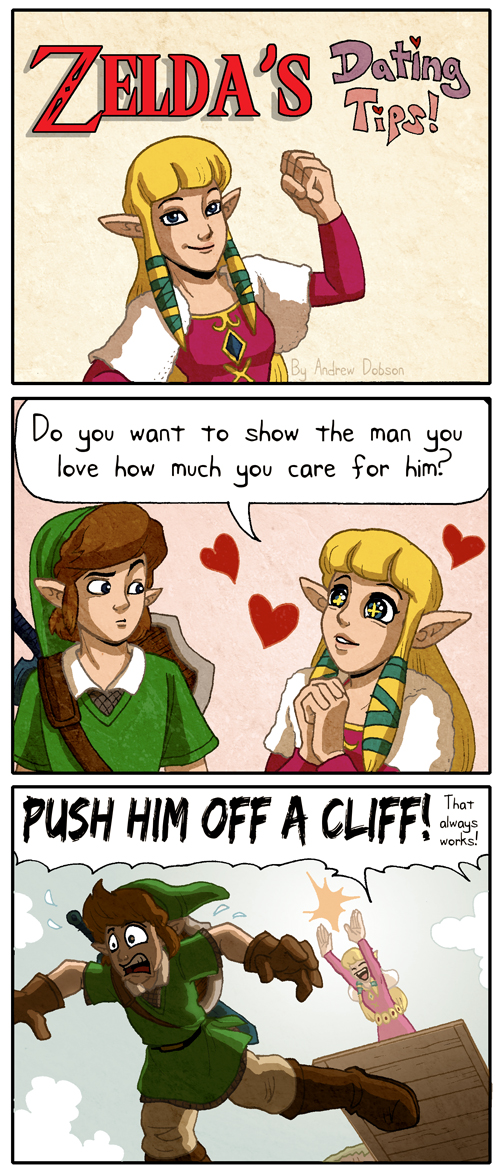
However, the design cannot cover up some of the game's biggest shortfalls.  I wish the worst I could say was that I was mesmerized into stupidity by Zelda's bangs, but it was far worse...

The first game flaw is the flavor of the month assistant, Fi.  While I have to accept the fact that Nintendo insists that its players are idiots and need an assistant to give guidance on every single facet of the game, I am greatly disturbed by the intense level of assistance that is constantly offered.  After learning about Zelda's next location, I can barely breathe before Fi errupts from the sword and says: "I'm 80% certain that Zelda is in this location, we should go there."

There are a lot of missed opportunities in Skyward Sword to establish some components of the overarching universe.  Story-wise, the game stands steady, but I'm disappointed at missed opportunities to add depth and explain the origins of long-standing Zelda characters.  At times, it almost felt like a game that was not designed to be a Zelda game, but was turned in to one.  Not that Nintendo hasn't done that before...

A Stalfos battle, requiring a specific Wiimote swing.
And finally, my misgivings couldn't be complete without commenting on the Wii MotionPlus motion controls.  The game boasts the use of MotionPlus in combat and solving puzzles, but in reality, it is an incredibly painful addition.  The Wiimote is critical seconds behind during combat situations, wherein almost every enemy has a motion-based defense, encouraging forcing the player to swing the Wiimote one direction or the other.

But if combat is clunky, it seems next to graceful compared to the Wiimote motion controls of the game's various mini-games.  Mini-games, and subsequent cursing at the world while playing them, are a staple of the Zelda world; however, these mini-games are rage inducing.  Not only must you contend with achieving scores that are nigh undoable, but you must also achieve those scores by using frustrating and inaccurate controls.

In spite of these shortcomings, the game is a lot of fun, albeit frustrating at times.  If you haven't grabbed it, check it out!

Link to purchase from Amazon.com: The Legend of Zelda: Skyward Sword with Music CD.